
Timau, Burguret and Kamweti: Mount Kenya’s Less-Travelled Routes
Beyond Sirimon, Chogoria and Naro Moru lie three routes that see a handful of parties a year. No huts, no queues, and often no path.
Most people climb Mount Kenya by one of the three main routes, and with good reason — they are well supplied with camps and huts, and they work. But the mountain has other ways up, and for experienced trekkers who want genuine wilderness rather than a well-worn trail, these are worth knowing about.
All three are camping-only, guide-essential and weather-dependent. We run them on request rather than to a fixed schedule, and we will want to talk to you about your experience before confirming.
Timau Route
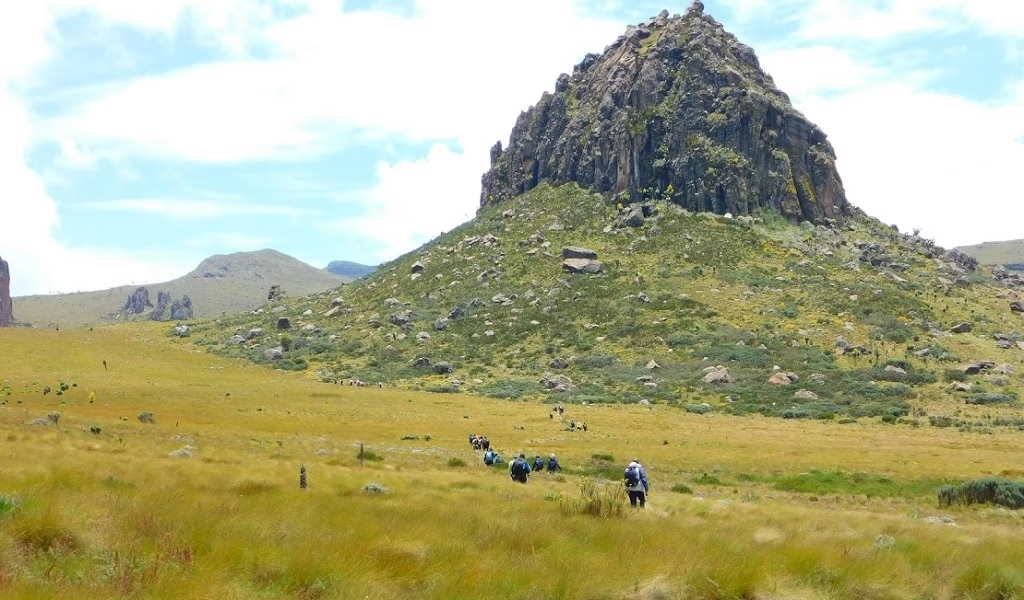
The north-eastern approach, starting from the Timau side of the mountain and crossing high, open moorland with wide views across the Laikipia plains. It is the driest route on Mount Kenya and the least defined — long stretches have no path at all, and navigation is entirely on your guide.
Best suited to trekkers who have done a main route before and want something wilder. Usually joined to a Sirimon or Chogoria descent, over six to seven days.
Burguret Route
The wildest of the three, climbing the western side through dense forest and bamboo where the Mau Mau sheltered during the emergency. The lower section passes the Mau Mau caves and Burguret waterfalls, and the forest is thick enough that a machete is sometimes part of the kit.
Burguret carries a real chance of encountering elephant and buffalo at close quarters in dense cover, which is the main reason it needs an experienced guide. Access is also restricted in places because of a military installation nearby, so it takes advance arrangement. Typically six days, descending Sirimon or Naro Moru.
If it is the forest and bamboo you want rather than the difficulty, our Sirimon Gate to Old Moses section gives a similar experience with far less complication.
Kamweti Route
The southern approach, rising from the Kamweti forest through some of the densest vegetation on the mountain. It is the least used of all the Mount Kenya routes and the hardest to arrange, with no established camps on the lower section.
For strong, self-sufficient parties only, and usually run as a six or seven-day traverse finishing on the Chogoria side.
What these routes have in common
- Camping throughout — no huts or bandas on the approach
- Full crew required: guide, cook and porters
- Sections with no marked path, so guiding is not optional
- Higher chance of close wildlife encounters in dense forest
- Weather-dependent; we may move you to a main route on safety grounds
- Best combined with a descent on Sirimon, Chogoria or Naro Moru
These three are quoted per trip rather than off a standard price list, because they vary more than the main routes do — in length, in access, and in what has to be arranged to get you to the start. They also tend to attract people who want something built around them rather than a fixed itinerary.
What’s included is the same as any of our treks: KWS park fees for the full duration, your KWS-certified guide, cook and porters, three cooked meals a day and hot drinks, camping or hut accommodation, tents, sleeping bags and walking sticks, road transport at the start and finish, and drinking water throughout.
Send us the route you’re drawn to, your dates and your group size, and we’ll come back with one price for the whole thing.
Book the Less-Travelled Routes
Tell us your dates and group size and we will send a day-by-day plan built around them.
Message Us on WhatsApp